Search This Blog

Showing posts with label The Battle of Broken Moon. Show all posts

Sunday, June 2, 2019

"See your memories." by Michael E. Gonzales


I received one of those “See your memories” notices from facebook this morning.
“Three years ago…” and it displayed one of my early “art” works I used to advertise my first published book, Dark Moon Rising.
Three years and a few months ago I was just a guy writing in his spare time. A suggestion was offered that I might find writing cathartic. I had tried my hand at writing while still on active duty in the Army. As you might imagine an Army officer has very little spare time for any pursuit outside of his normal required duties.

Additionally, I wrote by hand, on paper, with a pen. Imagine.
Needless to say, that poor attempt was worthless, but I did enjoy it.
When I started writing again, I tried writing a fictional story set in WWII, drawing heavily on my own experience which, it turned out, was not a good idea.
That partially completed eight-thousand-word manuscript still exists, but it’s on a floppy disk and so lost to the world…thank heavens.
Sometime later I took my then young son to a science-fiction movie he wanted to see. The story concept was a good one but the movie was terrible. I thought to myself as we left the theatre, I could write that story better than that!
So, I put my computer where my big mouth is and sat down and did just that. I showed the completed work to friends who are sci-fi fans, and one fellow who’s a hard core “Trekkie.”

Every one of them said they really liked it, but I had a lot of punctuation errors and more than a few spelling mistakes.
Well, I started to generate stories and commit them to digital paper.
After I’d written over twenty stories a friend suggested I submit one to a publisher. I blew that Idea off. But, it sat, fermenting in my mind.
So, I started reading up on how to get published. I read all I could about query letters. I found gobs of Sci-Fi publishers who accepted these letters from unproven writers and started sending them out to all I could identify.
A couple actually asked to see the first three chapters. However, all ended up send me nice, boilerplate, rejection letters (I’ve kept them all).

Then by a happy circumstance I met Cheryl. I was only told that she used to be an editor and perhaps she could give me some advice.
We met one lovely afternoon for lunch. And we chatted for over two hours. She did indeed have great advice for me! I wrote it all down (still have the notes).
She asked that I send her my first chapter and she’d look it over.
After a few days she sent an email suggesting I get the manuscript professionally edited then send her the complete document.
After I learned what the editing was going to cost, I almost decided to let the entire matter drop.
        It was my wife who encouraged me and pushed me over the edge.
Once the editing was done, I sent the manuscript to Cheryl, all the while hoping I’d get it back loaded with advice and suggestions on how to improve my writing.
Some two or three weeks later I received an email from Cheryl explaining that she was with Prairie Rose Publications and offered me a contract.
I can’t begin to describe the since of surrealism that engulfed me at that moment.
I had to read the email and the contract twice more, then, I ran screaming out of the den looking for my wife to show the message to her.
“Are we reading the same thing?” I asked her.
Well…three years later and I have five books on the market, and a sixth awaiting publication.

With each published book I still get the same feeling, the same butterflies, as I did with the first.
And when I pick up any of them off my bookshelf and see my name on the cover it’s still surrealistic.
Was it fate, synchronicity, luck? I don’t know, may never know. But I do know that I owe a debt to Cheryl and the lovely people at Firestar Press who rolled the dice on me.
Thank you.


Fire Star Press Blogspot -http://firestarpress.blogspot.com/


Monday, May 6, 2019

Waxing poetic by Michael E. Gonzales


        Allow me to “wax poetic.”

Which of course means to use flowery or expressive language to describe a relatively mundane topic, or use heightened, formal language to communicate a simple thought.

I’m in the middle of writing a story that, when the idea first popped into my head, sounded great!
The outline looked good as well. But as I began to tell the story and to ensure my twists twisted and plotholes weren’t bottomless that “thing” happened; I call it … mission drift.
Somewhere between my brain and my fingertips the story branched off.
The blank page became a swirling haze as the story loomed up out of the abyss and was illuminated by the light of foreboding imagination. Visible before me was a labyrinth of paths so vast as to befuddle the mind of the most indefatigable sage.
Within the mists the events of the outline conflicted with the ever-active imagination. In that instant, as if from a flash of lightning,
was shown the dark tunnel down which the story was hurtling toward a future of pain, misery, confusion, and the slow tedious process of rewriting.
This cloudy road quickly forked, then forked again, and yet again — for neither imagination nor storyline now follow a straight line.
There is always hope for any manuscript.
But hope, in perpetuum, is opposed by evil, and so it is in the mind of this writer. The ruby flames and blood red demons of ubiquitous malevolence threatened even now to consign the manuscript to the dark,
irretrievable depths of the rubbish bin.


The time spent in research, the hours pounding at the keys till my fingertips bleed, the gallons of coffee and the sleepless nights, all for naught.

By the glow of my monitor I gaze out into a darkened room, the only sound the pitiless ticking of the clock. I am loathed to surrender to the demons, so I turn to the better angels of my mind and plead for help.
The answer I knew before I asked. It came to the forefront of my mind as a hard and painful slap with a mailed fist…
“Work harder, ya fool, and quit whining!”
I am reminded of the famous quote:


 Please follow me, I know where I'm going!


Fire Star Press Blogspot - http://firestarpress.blogspot.com/


Monday, October 1, 2018

Experience By Michael E. Gonzales


I started writing a new story that takes place back in 1899, and not because I’m infatuated with 1899 but because it places by characters in the time I need them in to match both historical events and events as written by another, and very famous, writer of science fiction from the genre’s early beginnings.
Next, I have to get them to a very specific location. This will by necessity require me to write about travel. I’m fortunate in that in my life I have traveled a great deal. This provides me some insight. And better yet I have traveled on a ship, which if your traveling about the world in 1899 there is pretty much only horses, trains, and ships to get around on (there were a few automobiles but very, very few).
My characters will have to traverse rugged mountainous terrain as well and dense forests in rolling hills. Yup, you guessed it…I’ve been there, done that.
“Okay, Mike, nuf bragg’n what’s yer point?”
Point is, every writer must draw on what they know and what they have experienced. Does this mean if you haven’t walked twenty-five miles in a day through a forest where the temperature is twenty-two degrees that you can’t write about it? Well, of course not.
First, what I do, is remember a time when I was once bone tired but knew I had to push on. After a hard day at the office ya got one last stop at the store, drag yourself through the isles to get what you need to go home and cook dinner!
Remember when you were last out in very cold weather for a longish time, remember shivering against the cold, pulling your collar up, burying your hand deep in your pockets.
Remember strolling through a fairy tale forest (or seeing a movie set in a fairy tale forest).
Next, I roll up all those memories, extrapolate (a highfalutin word meaning to deduce or guess) and then, here’s the hard part, see yourself dead tired in a freezing wood with miles to go before you sleep.
Again, I realize I’m preaching to the choir here and I know that very likely every one of you has a different method to achieve this same goal. And I am also aware that there are some of you who when describing walking dead tired in a freezing wood with miles of path ahead―have actually done that (you poor thing, you!).
It can be even more difficult if your having to describe events on an alien world, or in the weightless environment of space (and no, I’ve not been into space―yet).
It’s been said countless time, “there is no substitute for experience,” and that is so true, particularly for writers. The big difference is that for everyone else experience is something to draw on to improve some aspect of your life, but a writer has to have the ability to describe that experience in the most vivid and emotional manner possible.
You write about the death of a beloved character in your story. As painful as it might be, recall the death of a friend, a parent, a loved one. Bring up all the pain that you spent years suppressing and pour your tears onto the page. Hold nothing back.
If it doesn’t make you cry, neither will it your reader.
One of the most difficult things I have experienced about writing is the pain of vomiting up old memories, and the struggle to put that pain on paper.
If done well, you will know the joy of having written something people, hopefully, will want to read while at the same time experiencing your own cathartic event.
                                   Just keep writing! 


Please visit my Web Site:  http://www.mikegonzalesauthor.com/home.html


Thursday, June 1, 2017

Research, by Mike Gonzales

Wow, we're about halfway through the year, already! Hard to believe. It seems just like yesterday that I was celebrating the release of my second novel, “The Battle of Broken Moon,” but that was back in March.


So far, I feel as if I’ve already packed a year into five months.

Recently, I have been giving thought, just for the purpose of experimentation, to writing outside my chosen genre. All my ideas and concepts always seem to come about, and morph into Sci-fi, and or, Fantasy.


Having an interest in the genre within which you write is, to my mind, paramount. I can’t imagine sitting down to write something for which I have no interest: stamp collecting, and golf, come to mind.

Now, it is not my intent to belittle either philately or the links, they just aren’t my cup of tea.

Regardless of how enthralled an author may be with the tome they are pouring their emotion into, there is always something that author must become more familiar with in order to give the story gravitas. Be it the right way to saddle a horse, the correct lay out of a long forgotten western town, or thrust to weight ratios.

I have learned a great deal in the researches I’ve done in support of my Sci-fi novels.

I’ve learned about new technologies that promise humanity a much faster ability to sail between the planets.

I’ve discovered the “multiverse”, the theory that points to an endless number of universes all around ours, like billions of soap bubbles crowding a child’s birthday party.
The possibility that there is a countless number of me out there, each making a different decision at every question; answer the phone or no, turn right, left, buy that house… each decision spiraling that other me into an entirely new future. It’s called, “string theory.”


I have come to understand that the universe is far stranger, and more complex than the human mind is capable of comprehending.

On a positive note, this means that no matter how outrageous, outlandish, weird, or bizarre an author paints his world, either in deep space, or on planet Earth…he can’t be wrong.

It’s all possible, in string theory.

          At night, as I gaze up into the heavens, I imagine my eyes as super powered light receptors. From beyond the Moon, beyond the Milky Way, past the stars in Orion’s belt, and the great Bootes Void, outside the realm of the visible universe come superluminal communications in data bursts too fast to be detected by poor terrestrial sensors.


Within these communications come stories of great daring, accomplished by individuals who reside on other planes of existence, some as far away as the Hercules Supercluster. Others from entire universes that exist all around us, in the same space, and others deep within a single fleck of dust now sitting atop a long forgotten book in your own library.

As the Bard speaketh, “There are more things in heaven and Earth, Horatio — than are dreamt of in your philosophy.”

Amen.   


Visit my page, Michael Gonzales, fictionist: http://www.mikegonzalesauthor.com/home.html


Monday, May 1, 2017

Escapism - by Michael E. Gonzales

     One of the definitions of Escapism is: “A mental diversion by means of entertainment or recreation, as an escape or dissociation from the perceived boring, arduous, scary, or banal aspects of daily life.”
     Undoubtedly, there is some truth to that, but I believe some of us just enjoy a good story!
The Great Hunt

     Humans have been telling stories to one another for time immemorial. Troglodytes once gathered around the fire in the safety of their caves to relate stories of the day's hunt. I have no doubt that the hunters would oft times exaggerate―and so, fiction was born!
     Likewise, cave drawing, and hieroglyphics painted inside ancient tombs, told stories―stories of the pharaohs’ great victories in war, or of the mass sacrifices the Maya and Aztec made to their various gods.
     The Sumerian ‘Epic of Gilgamesh’ was first written down somewhere between 2150–2000 B.C.!
The Epic of Gilgamesh 

     Along came paper, bound together, and books were invented. It really wasn’t until the invention of the printing press that books became available to the masses―well, the masses who could afford them.
     Then, in the 18th century, there began to appear books delving into topics other than religion, science, and poetry. Stories of romance, and then adventure. Robinson Crusoe, by Daniel Defoe, was published in 1719. Frankenstein, or, The Modern Prometheus, was written by English author Mary Shelley, and published in 1818.
Frankenstein and his monster

     Then came the grandfather of modern science-fiction, Jules Verne,
Verne's Nautilus

whose stories of great adventure and scientific achievement began in 1862. Of course, he had his contemporaries: Camille Flammarion, and Edward Bulwer-Lytton to name a couple. But no author reached the level of Verne until…H.G. Wells.
HG Wells

     Wells's stories use science fiction devices that both entertain and make points about the society in which he lived. In The Time Machine, published in 1895, the technical details of the machine are quickly glossed over, so that the Time Traveler can tell a story that criticizes the stratification of English society. In The War of the Worlds, published in 1898, the Martians' technology is not explained, as it would have been in a Verne story, and the story is resolved by a deus ex machina, albeit a scientifically explainable one.
     The differences between Verne and Wells highlight a tension that exist in science fiction to this day. The question of whether to present realistic technology, or to focus on characters and ideas. 
Thus, the difference between science fiction, and what is called, hard science fiction.
     An author must decide whether to write an exciting story, and make only a passing reference to science, or write a story that adheres strictly to the science behind the story.
Then the author must decide if his story is going to make an obvious or an underlying didactic point. In our modern age of heightened sensitivities, this can be a very dangerous thing to do, as someone is likely to be offended. This could mean the alienation of a segment of your market, and even result in "bad press" on social media. However, as a wise man once said, “All press is good press.”
     I don’t know that any author attempting to be a futurist can write anything that does not make a political statement. The most benign description of a future culture or civilization can’t help but exclaim the form of government that the author sees surviving the test of time.

     Here, the author must walk a thin line. Should the author, in his/her attempt to be educational and moralistic, be perceived as "preachy" they may very well drive readers away.
     It is, I think, important that fiction―all fiction―should make a statement about the human condition. But to do so too loudly will remove the author’s work from the genre, “escapism.”
     Every author’s work I cited above made a point about humanity. The author entertained us, and left the thinker with something to chew on. The best authors’ stories, and messages, have transcended time.

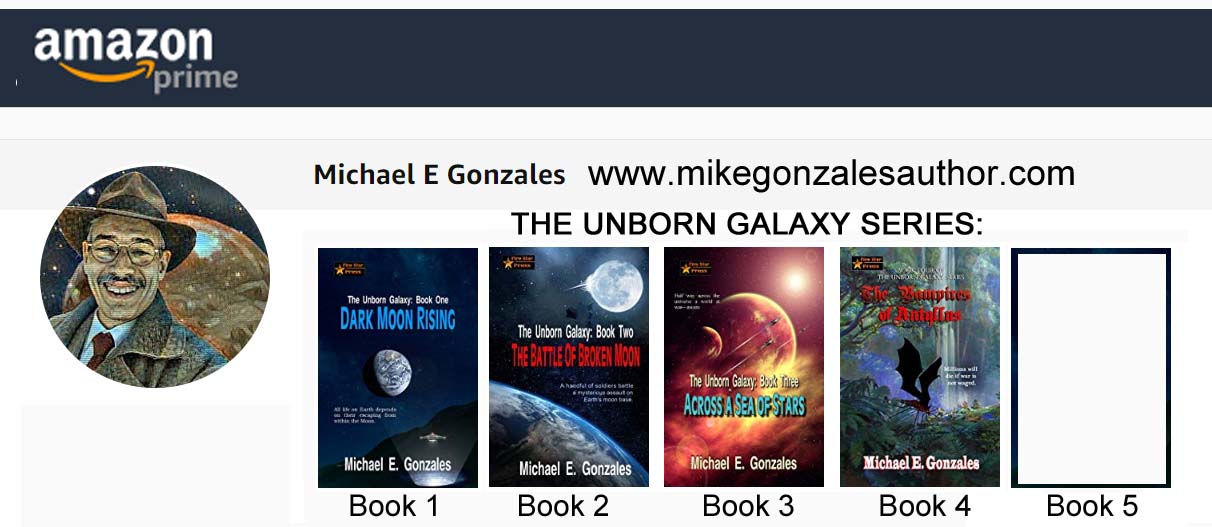
Look for book III of the Unborn Galaxy series, "Across a Sea of Stars," coming out soon.


Saturday, April 1, 2017

The journey continues, by Michael E. Gonzales.


In Book one, Dark Moon Rising, of the The Unborn Galaxy series, you were introduced to JILL, the Joint International Lunar laboratory, on the Moon’s near side, setting inside Mare Insularum, the Sea of Islands. Here you witnessed the horrific and unprecedented lunar quake that sent one of the habitats, and eight humans, plummeting into a sub-lunar world fraught with danger, and complicated by the gambit of human emotions, frailties, and lusts, all seeming to conspire to end their lives. And then they encountered the lost alien colony.
  
In my second book, The battle of Broken Moon, you watched as the survivors of the quake fought to stay alive and evacuate the base. You saw their efforts thwarted by traitors, and an invading force from space.

In the coming third book, look for some subtle clues that will point toward the series finale.

The third story in the series starts on JILL, with a mystery that dates back to the Apollo 15 Moon mission of 1971, and the mysterious photographs of what appeared to be a large cylindrical shaped spacecraft, lodged in a crater on the far side of the moon.


Then came the top-secret Apollo 20 mission which took place in August of 1976. The Apollo 20 mission objective, according to Mission Commander William Rutledge, was to land in proximity to the cigar shaped alien craft, spotted by Apollo 15, and then conduct a detailed survey and exploration.
A Saturn V rocket was the launch vehicle, and the Apollo space craft made the trip, and landed on the far side of the moon where two of the three astronauts, one American, and one Soviet, explored the massive alien craft before returning to Earth.
Their findings were so startling, so unnerving, so explosive, that the entire mission was buried, and both the Americans and the Soviets agreed to deny the mission ever existed.
But the films and photos remain on file, and on line, for any to see…to this day.


The story, the cover up, the controversy, the conspiracy had long been forgotten when a series of extraordinary events on the lunar surface caused a reexamination of the record.
Captain Cristóbal "Chris" Salazar, a career Air force officer, who had trained for years for the Mars mission suffers a devastating blow when he was passed over and thus prevented from joining the Mars crew. He is cast into a deep depression, but when offered a posting on the Moon…he grudgingly accepts.
Arriving on JILL almost a year after the great quake, Chris is made the pilot of a Lunar Eagle, a small low orbital vehicle designed for transport, and survey work.
When the “anomaly” begins, he is selected, because of his skill as a pilot, to fly an Eagle to the event site, and launch a probe.


The probe sends back telemetry and images that shock the scientific community.
As a result, the military want to destroy the anomaly. But instead another, more sophisticated, probe is ordered delivered into the mysterious event.
When asked, Chris volunteers for the dangerous return trip. This time the unimaginable happens. He is drawn into the event horizon and vanishes from sight, off sensors, and into an adventure both horrifying and wondrous. He will face great malevolence, monstrous creatures, zombie like humanoids, evil magic, and worse yet, his own demons.
Chris will also find a treasure worth more to him than even his life. To possess this paragon, he will forever sacrifice his chance to return home, Across a Sea of Stars.

(Take a look at the pictures and film footage of the alien craft by looking on YouTube for “Apollo 20 William Rutledge”)


Visit my page, Michael Gonzales, fictionist: 
http://www.mikegonzalesauthor.com/home.html

https://www.amazon.com/…/B01CB…/ref=cm_cr_arp_d_product_top…
https://www.amazon.com/Battle-Broken-Moon-Un…/…/ref=asap_bc…
Follow me on Face Book: https://www.facebook.com/profile.php?id=100010275572869


Wednesday, March 1, 2017

Are we alone? By Michael E. Gonzales

Wow… what a week for science, eh? In addition to the other dozens of exoplanets discovered “out there”, seven new planets were discovered orbiting a relatively close star, TRAPPIST-1, only forty light years away!
Even more remarkable is the fact that three of the seven are located in what’s called the habitable zone, that ring around any given star where water can exist in its liquid form―liquid water is essential to the development of life―“as we know it.”  

These planets are roughly the same size as Earth, possibly older than Earth, so…this begs the question…is there life around TRAPPIST-1?

If so, is it just primordial, single-celled creatures in a soup of life, or mere microbes?
How deep does your imagination run?
Perhaps they are closer in development to Neanderthal man?
Could they be as advanced as we were in say, 1939, living in great cities, in command of electricity, dominating their seas, and flying through their atmosphere?
Or, just maybe, they are more advanced than we. Perhaps they already know about us, their instruments having detected our solar system a millennium ago. Who knows that they haven’t been listening to our transmissions, even visiting us since eons past―and are still?
Then why have they not contacted us? Sent us a signal of some kind?
What if a massive solar flare, or a collision with a comet, or―war, laid waste their once mighty civilization, and all that is to be found on their world is the skeleton of a once learned, cultured people, now lost for all time.
Were they advanced enough to hedge against such an eventuality? Had they outposts on one of the other worlds of TRAPPIST-1? Perhaps colonies far outside their own solar system? The nearest habitable world to theirs lay a mere forty light years away.
Did they come here in man’s distant past? Did they build the pyramids found around the world, were they the builders of Machu Pichu, Teotihuacan, and Angkor Wat? Are we the last vestige of their civilization?


Or maybe…they are on their way here now? A vast armada moving at near-light speed toward a technologically inferior species with the goal of conquest and genocide?


It may be possible that they launched an ark, a vessel containing the DNA of every life form on their world? And should we discover it, would it be wise to open that Pandora’s box?
Are the lines between science, science-fiction, and fantasy beginning to blur? No less a mind than Stephen Hawking warned mankind, “It is perfectly rational to assume intelligent life exists elsewhere. If aliens visit us, I believe the outcome would be much as when Columbus landed in the Americas.” Which, as we all know, didn't turn out well for the Native Americans.
This is the dystopian view.
Another view is that the more advanced a civilization is the less violent, and the more curious. Aliens might very well turn out to be an altruistic race, come to learn and to share their knowledge.
If the decades-long rash of UFO sightings is any indicator, then they are more like Captain Kirk following his prime directive; observe, do not interfere. And like Captain Kirk, doing a lousy job of it.
Seven new worlds. But this is nothing compared to all we have thus far located in a patch of sky no larger than a postage stamp held at arm’s length. Weekly, it seems, dozens of planets from this “tiny” spot are added to the exoplanet database. At this writing, there are 3,453 confirmed planets, and another 4,696 Kepler candidates.
It is likely we will know the answers to the questions posed above sooner than we might suppose.

Watch the skies.
And pick up Books I and II of The Unborn Galaxy -- while there's still time.