Search This Blog

Monday, May 24, 2021

80 years ago May 24, 1941– HMS Battleship Hood sinks by Kaye Spencer #prairierosepubs #sinkthebismarck #classiccountry

Classic country music singer Johnny Horton had a Top 10 song in 1960 called Sink the Bismarck. The song is a ‘novelty’ song, and it was inspired by the movie of the same name, which was also released in 1960. The movie was based on the 1959 book by C. S. Forester, The Last Nine Days of the Bismarck. The song was not included in the movie, but it was used in the U.S. movie trailers.

(Side Note: C. S. Forester wrote The African Queen.)

Johnny Horton
April 30,1925 - November 5, 1960
Image License: Fair Use

There were production concerns for the song because it was feared the history/story of the Bismarck was too obscure in the U.S. to be a success. That issue didn't materialize, because the song reached No. 3 on the U.S. Billboard Hot 100, No. 6 on the U.S. Billboard Hot Country Singles, and No. 1 on the Canadian RPM Top Singles.

So, what does the song Sink the Bismarck have to do with the sinking of the British battleship Hood?

A brief explanation:

Coming into World War II, the Bismarck was one of two ‘Bismarck-class’ battleships. Her sister ship was the Tirpitz. They were named for the German Chancellor Otto von Bismarck. At the time, these two ships were Germany’s largest battleships with all the bells and whistles that made them coveted by the world’s navies, even while still in blueprint status.

The HMS Hood, an Admiral-class battlecruiser, launched in 1918 and was Britain’s largest battle cruiser. According to Wikipedia, it was the lead ship of her class of four battlecruisers built for the Royal Navy during World War I. 

The outbreak of World War II in September 1939 interrupted the Hood's planned rebuilding to outfit her with the latest technology. She was brought back into service without the upgrades, which made her vulnerable.

The Bismarck was a battleship to be reckoned with. It was part of the German Operation Rheinübung, which was a plan to block merchant shipping to the United Kingdom. If Germany could successfully set up a blockade to prevent ships from reaching the UK with the food, supplies, and essentials they needed, then Germany reasoned the British Empire would negotiate a surrender, so to speak, and Germany would then control Western Europe.

Consequently, British cruisers were on the lookout for the Bismarck. She was spotted in the North Atlantic. In the ensuing engagement in the Battle of the Denmark Strait, the HMS Hood was sunk, taking 1500 crew with her. Only three of the crew survived.

The Bismarck sailed for the French coast with a seriously damaged fuel tank. Three days later, British war ships caught up with the Bismarck and torpedoes finished her off. Among the casualties was Admiral Lutjen.

Operation Rheinübung was abandoned after which Germany depended upon the U-boat for sea warfare. 

Investigations into why the Hood sank so quickly turned up differing theories.

1. aft magazine had exploded after one of Bismarck's shells penetrated the ship's armor.

2. explosion of the ship's torpedoes

3. accidental explosion inside one of the ship's gun turrets that reached down into the magazine

The remains of the Hood were discovered in 2001. It is generally accepted that the magazine explosion was the cause, however, the reason the magazines detonated can't be determined, because that area of the ship was destroyed in the explosion.

Here is this World War II sea battle immortalized in song by Johnny Horton.

Sink the Bismarck

This is the YouTube link if the video doesn’t appear on your device. https://youtu.be/M1Ufc2hI4FM


Until next time,
Kaye Spencer

Writing through history one romance upon a time


 Additional References:

This Day in History - Bismarck sinks the Hood 
Sink the Bismarck song 
Operation Rheinübung 

Look for Kaye here:

Facebook
Instagram
Blogging
Twitter


Monday, May 17, 2021


Character Traits - Ruben D. Gonzales

Writing about characters and their physical appearances is a talent. The challenge is to write just enough to make sure your characters are believable without dumping a lot of useless descriptive stuff that doesn’t help the story along. If you describe someone as fat/heavy/ stout then make sure there is a reason that a character’s weight is important in the story. If you just say your detective weighs 240 pounds but then the character is never affected by the extra weight in your story then the words were wasted. Why not say he was skinny then?

You could say… It was a good thing Richard weighed 240 because he needed every pound to move the boulder off of Emma’s pinned leg before the water rushed in and drown her right before his eyes.

Or … The teenager took off like a bullet and in 10 seconds put a hundred yards of hot black pavement between them. Richard hated to run and labored if he ever did. When he got to the end of the block he turned the corner and stopped and looked. The kid was a speck disappearing in the distance and Richard knew a quick end to the case disappeared with him.

In my latest book – Murder on Black Mountain – my main character, Emma Shaw, can read auras. That’s a pretty interesting character trait, maybe interesting in all by itself. But for Emma, she uses the gift to help solve the mystery of her brother’s murder, so it is much more than interesting. It is essential in the story.

Make sure there is a purpose for your main character to wear glasses. Maybe it’s a sign of his intelligence, or shyness, or he uses it as a prop when making a point. Also, if you are going to use the prop effectively then make sure it is used at other times in the story besides at the beginning when you introduced him. And don’t forget he is wearing those glasses when he comes in from the rain. Wouldn’t he need to take a moment to wipe them off? Perhaps like…Once inside the entryway Richard took off his glasses, pausing to wipe the rain drops from the lens, and using the time to formulate a plausible reason to explain his finger prints at the murder scene.

I’ve taken a few writers seminars and on this character topic we were instructed to make a chart of all our characters and list all their attributes from the physical to the emotional. What do they like to eat, watch, read, smell, or drink? Do they like to exercise or are they the sedentary type. Of course most of the traits for the minor characters never make it into the story and only the very main characters get a chance to use the full range of character traits. But the exercise of writing down the emotional/physical traits of your characters ahead of time helps you organize the development of your characters through action and not just description.

Make sure each descriptive detail you write contributes to the characters actions. Keep track of the attributes you assign your characters to make sure the character stays in character throughout the story. If one of your main characters hates the water he probably should hate the water during the whole story, and you should mentioned that once or twice more during the story, especially if later he is forced to awkwardly jump into a raging river to save someone.

There are all kinds of people in the world so let's invite an eclectic mix of them into our stories.

www.rubendgonzales.com

Saturday, May 15, 2021

ARE YOU A POET AND DON'T KNOW IT? by Mollie Hunt, Cat Writer

April was National Poetry Month, and a writing group that I belong to decided to do something different to celebrate their annual poetry slam, Verse of Ages. The Oregon Writers Colony came up with the idea several years ago to invite poets of all ages to read their work. The first events showcased people from age ten to ninety. From there, it morphed into something more generational, from Greatest to boomers to X and wherever we are now. That was fun as well, especially the kids who got up and recited some of their original poems.

But then came Covid. Last year’s Verse of Ages didn’t happen at all, but by the time 2021 rolled around, everybody knew how to Zoom and there was no way we were going to give up our affair two years running.

Since everything had changed, the coordinator thought it might be fun to change up the format as well, so at the beginning of April, she sent out a prompt word for every day of the month. There were no rules: do or do not; do some or all; write separate poems, or like one person did, incorporate all thirty words into a single poem. At the beginning of May, we all got virtually together to share our results.

Some of us are actual poets, where others had never touched the genre. I write the occasional poem and have even published a little book of cat poems, but I don’t consider myself a poet by any means. Still this prompt-a-day idea caught my imagination. I missed some days and skipped or made up for them later, but I got a lot out of it. Now I’ll share a few with you.


 April 2 PATHWAY


Pathways


We walk the edge of the abyss,

fragile as moth wings

but with a phoenix heart.


  April 6 JOURNEY


Don’t they say

life is all about the journey,

not the destination?


Still, sometimes I wish

I could get off this bumpy stagecoach

and rest by a tree,

by a lake,

under the long sky,

to finally call it home.


Photo by Yi Liu on Unsplash
Photo by Yi Liu on Unsplash
 

April 10 ANSWER


If love is the answer,

then what is the question?


What comes after loss?

How do I deal?

Why are we here?

What makes us human?

What keeps us sane?

Why do I have so many cats?


April 12 GRACE


My Aunt Grace

was old and scary,

with penciled eyebrows

too high upon her forehead

and a red mouth

full of frowns.


I recall her at her vanity

like a nineteenth-century

memento mori,

black lace shrouding scrawny shoulders.

A tiny dragon,

she hovers over her hoards of

costume jewelry.

Rubies and emeralds,

sapphires and diamonds

but not even their sparkle

can bring life

to that pale face.


 April 15 DANCING


At night,

when we’re in bed,

the cats go dancing.

Cheek to cheek,

they twirl across the floor.

to the tunes of the mouse band.

Missy in her ball gown and

Tom in his tux,

around and around they cavort

until the crack of dawn.


No wonder

when we come down

the next morning,

the cats are fast asleep.


April 27 SATCHEL


Somebody was running out of prompts

when they chose the word satchel.

No one uses that word anymore.

It’s briefcase or suitcase, bag, purse, or tote,

It’s knapsack, backpack, or pouch.

But satchel, old satchel,

has gone the way of the saddlebag,

to lie lost at the back of the closet

with the dial telephone and

the reel-to-reel tapes.


About Mollie Hunt: Native Oregonian Mollie Hunt has always had an affinity for cats, so it was a short step for her to become a cat writer. Mollie Hunt writes the award-winning Crazy Cat Lady cozy mystery series featuring Lynley Cannon, a sixty-something cat shelter volunteer who finds more trouble than a cat in catnip, and the Cat Seasons sci-fantasy tetralogy where cats save the world. She also pens a bit of cat poetry. 

Mollie is a member of the Oregon Writers’ Colony, Sisters in Crime, the Cat Writers’ Association, and Northwest Independent Writers Association (NIWA). She lives in Portland, Oregon with her husband and a varying number of cats. Like Lynley, she is a grateful shelter volunteer.

You can find Mollie Hunt, Cat Writer on her blogsite: www.lecatts.wordpress.com

Facebook Author Page: www.facebook.com/MollieHuntCatWriter/

@MollieHuntCats


Monday, April 26, 2021

He put the twang in Rock & Roll by Kaye Spencer #prairierosepubs #rocknroll


Today is Rock ‘N Roll guitarist Duane “The Titan of Twang” Eddy’s birthday!
(b. April 26, 1938 - Corning, New York)

The guitar image is Eddy’s Guild Guitar courtesy Wikimedia Commons/Creative Commons (Claude Humbert) license, HERE.

Here are a few notable events in his musical life.

  • Began playing guitar at 5 years old
  • Formed a duo at 16 years old
  • Met disc jockey Lee Hazlewood at radio station KCKY in Arizona - Hazlewood later produced and co-wrote some of Eddy’s songs

           (THAT Lee Hazlewood who partnered/performed/produced with Nancy Sinatra and who also wrote Dean Martin’s hit song “Houston”.)

  • Break through song Rebel-‘Rouser, reached  No. 6 on Billboards’ Hot 100 Chart in 1958.
  • Performed frequently on The Dick Clark Show
  • Had short-lived acting career – appeared in two episodes of Have Gun, Will Travel and was in a the movies, A Thunder of Drums, The Wild Westerners, Kona Coast, and The Savage Seven
  • Debut album in 1959: Have Twangy Guitar, Will Travel – remained on music charts for 82 weeks
  • Married country western singer Jessi Colter in 1961 (1961-1968)
  • Produced albums, collaborated, and performed as guest guitarist with many artists, including Phil Everly, Waylon Jennings, and Willie Nelson
  • Grammy Winner: 1986 - Best Rock Instrumental: Peter Gunn
  • Rock and Roll Hall of Fame induction 1994

Here are three music videos. The URLs are included in case the videos don’t show up on your device.

Duane Eddy - Peter Gunn
https://www.youtube.com/watch?v=hhVFK9tYu84


Duane Eddy - Ghost Riders in the Sky
https://youtu.be/UMz8XRGxZdY


Duane Eddy - Rebel-
Rouser

https://youtu.be/gU43Vg8qg2A


Until next time,
Kaye Spencer

Writing through history one romance upon a time

Stay in contact with Kaye:

Facebook
Instagram
Blogging
Twitter

Sources:

Duane Eddy- Wikipedia 

Duane Eddy - New World Encyclopedia

Tuesday, April 20, 2021


As Time Goes By – Ruben D. Gonzales

In the great movie, Casablanca, the whole story takes place in only three or four days. There is a flashback scene that stretches the narrative, but still for being one of the great movies ever written, the short period of time is skillfully handled. There were four or five shots of Rick’s Café American, sandwiched around a market scene and the final scene at the airport (left) where Rick tells Elsa “We’ll always have Paris.”

Authors need to utilize time effectively in their writing. Time is not limited to flashbacks and prologues. In a protagonist’s typical day opportunities to enhance and clarify your story will revolve around effective use of time. These opportunities should be sized upon, “in the Rick of time”.

Over the years I’ve struggled with the time element in my writing. I’ve used elaborate calendars to map out the sequence of events and to make sure time flows in a logical fashion throughout the book. The calendar has caught many irregularities and I’ve been able to rectify those in the second and third drafts to make my story flow with the proper time sequence.

Publisher rejections are based on a variety of reason so getting the time frame and reference correct eliminates one more reason for a rejection.

As a writer you control how time passes and the resulting flow of the narrative. Some stories take place over a very short interval while others may take years. In my first book, “The Cottage on the Bay”, my main characters life was the interval and it took ninety some years to complete. In my second book, “Murder on Black Mountain”, my main character completes her case in a couple of weeks. Both required detailed time mapping to get the story right so it flows without disturbing the reader’s journey.

Many authors use the chapter heading to identify the time period (and sometimes place) the story is taking place in or transitioning to. This is a straight forward but useful tool, keeping everyone, including the author, on the same page and point in time. Other authors strategically incorporate a time reference at the beginning of a chapter or change in a point of view; “The sun rose over the horizon in a red ball.”

When revising look for opportunities to incorporate visual clues to the scene, there-by setting the time frame for what’s to follow. Be aware of the passage of time and don’t leave the reader behind. Use your character’s senses to denote the time frame. Make sure your characters are aware of the passage of time. Make time for creatively using the need for a bathroom, meal, sleep, and all the other time interruptions a normal human would need during a regular day.

Ruben D. Gonzales
www.rubendgonzales.com

Sunday, April 18, 2021

HOW A WRITER IS LIKE A CAT, by Mollie Hunt, Cat Writer


Photo by Paul Hanaoka on Unsplash

I just adopted a cat—another one—and as I watched this new boy do his cat thing, it suddenly occurred to me why my writer’s lifestyle fits so fluidly with that of the clowder*.  There are exceptions of course, like when Tyler thinks breakfast should be at five in the morning. I’m not an early riser and I don’t do anything before coffee. But in many ways, we are very much alike. 


Crazy in the wee hours.

Writers are known to get some of their best story ideas in the middle of the night. My cat Tyler seems to think that’s a pretty good time to dash around the house like a mad thing—not so different from me typing feverishly on my laptop at 3:00 a.m. 

Solitary among others.

Cats are aloof, no matter where they are. There may be ten other cats in the room, yet each of them rests in their own little bubble. Though some writers are gregarious, many are introverts whose way of adapting to life with people is to create a personal space for themselves alone. 

Tight focus.

Have you ever watched a cat go after a moth? They are fixated on their prey to such an extent that their skin twitches and their pupils dilate. It’s as if there is nothing else in the world. When I’m writing, I become so focused in my work that time ceases to exist. A gun could go off and I might not notice. 

Photo by Bill Stephan on Unsplash

Routine.

Anyone who knows cats has learned, one way or another, that cats thrive on routine. They have an established schedule and are unhappy when that schedule is interrupted or changed. Writers often share that respect for routine and can get very nasty when someone intrudes on their designated writing period. 

Some people won’t like us.

Just as some humans suffer from ailurophobia, there are those who don’t like writers either. “Dislike” may be too strong a word. Perhaps “misunderstand” would be more accurate. There is a misconception that a writers’ life is easy, merely jotting down stories on paper and picking up million dollar checks. If that were truly the case, I’d be jealous too, but unfortunately it’s not. 

Naps.

All creative endeavors require rest. Napping with cats restores energy to both cat and human.


Photo by Tucker Good on Unsplash


There are other ways writers are like cats, at least I enjoy thinking it’s so.

That’s all for meow.


*Clowder: a group of cats.


Cat Writer Mollie Hunt is the author of the Crazy Cat Lady Cozy Mysteries featuring Lynley Cannon, a sixty-something cat shelter volunteer who finds more trouble than a cat in catnip, and the Cat Seasons Sci-Fantasy Tetralogy where cats save the world. She also pens a bit of cat poetry. 

You can find Mollie Hunt, Cat Writer on her blogsite: www.lecatts.wordpress.com

Amazon Page: www.amazon.com/author/molliehunt

Facebook Author Page: www.facebook.com/MollieHuntCatWriter/

@MollieHuntCats

Sign up for Mollie’s Extremely Informal Newsletter at: http://eepurl.com/c0fOTn


Tuesday, April 13, 2021

End-of-Writing Rituals

It’s so satisfying to type those two short words, “The End,” after pouring your heart into a short story or novel for weeks, months, or perhaps even years.  I’m reminded of the opening scene from one of my favorite movies, Romancing the Stone.  Romance author, Joan Wilder, celebrates the completion of her latest novel with a glass of wine, then tosses her glass into the fireplace, followed by her cat’s plate when he finishes his special tuna dinner.  Here is a (low quality) YouTube video of the scene if you’ve forgotten it. 


There are many feelings you might experience at the end of a project, like happiness, satisfaction, relief, or even worry about what comes next - should you take a break, immediately get started with editing, or move on to your next project?  I’ve heard several writers advise that you should allow yourself a treat, like some frivolous shopping or a nice dinner out, and then take a short break from the project to give yourself some perspective.  


I, myself, feel relieved, happy, and a sense of accomplishment when I complete a writing project.  I haven’t developed a specific ceremony to acknowledge the occasion, so need to work on that.  I like rituals and believe they’re an important part of commemorating an accomplishment (or even a Sunday afternoon).  The glass in the fireplace routine would likely not go over well for me, however, with my gas fireplace and its ceramic glass cover, so I’ll have to think of something else.  Including my cat in the observance sounds appealing. 


We all know typing, “The End,” is not really the end, as the work will likely require re-reading, editing, writer group critiques, etc.  But just getting the first draft done is cause enough for celebration.


Do you have an end-of-writing ritual?  What do you do to celebrate finishing a writing project, or any other big project, for that matter?


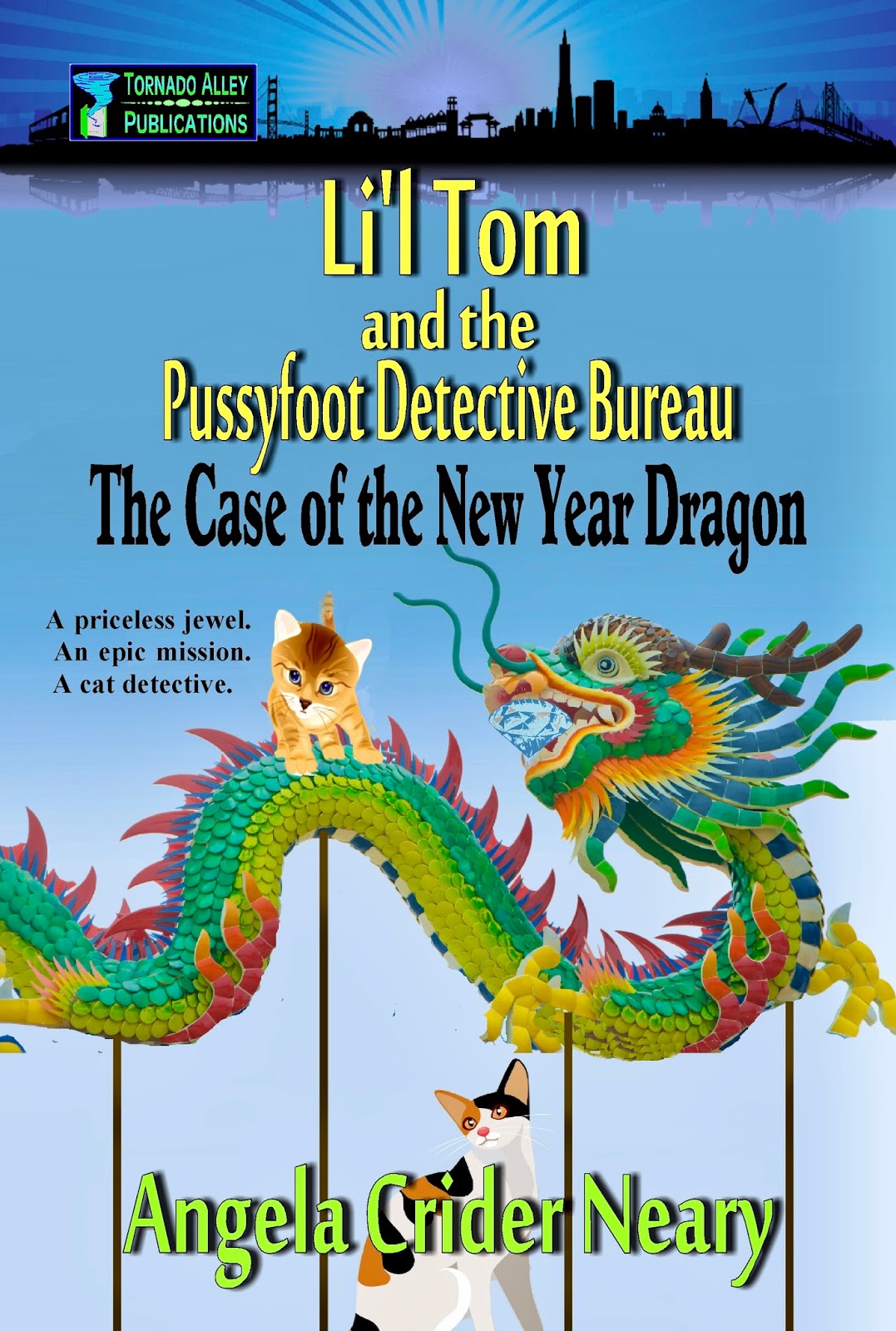
Angela Crider Neary is an attorney by day and writer by night. She is an avid mystery reader and especially enjoys reading novels set in interesting locales. She was inspired to write her first mystery novella, Li'l Tom and the Pussyfoot Detective Bureau: The Case of the Parrots Desaparecidos, by one of her favorite areas in San Francisco, Telegraph Hill.  Her second book, Li'l Tom and the Case of the New Year Dragon is now available.  To learn more, visit her on Facebook and Amazon.