Search This Blog

Tuesday, April 14, 2020

Free Short Story!

I hope you and yours are staying well and safe.  Rather than writing about what I’ve been keeping busy with during my time at home, or suggesting things that you might do to stave off boredom during these strange days, I thought I would share a short story with you - something to take your mind off the seriousness of what our world is dealing with, if only for a moment.  Hope you enjoy this light-hearted reimagining of one of my favorite tales. 

Tex and his Stetsons
A Fairy Tale Reimagined
by
Angela Crider Neary


“Ma always did like you best,” the eldest son said to the youngest.  Three brothers had gathered in front of a lawyer’s office for the reading of their dear old Ma’s will.  
“Yeah,” the middle son said with a snort, arcing a rusty sputter of tobacco from between his lips that splatted on the fiery pavement and sizzled.  July in West Texas was sweltering, to put it mildly.  “You was always the spoiled little pet.  You better hope she didn’t leave the whole kit and caboodle to you, or there’ll be hell to pay.” 
“That aint true!” the youngest said.  Although he knew Ma had loved them all the same, she had coddled him more to shield him from his brothers who would often gang up and bully him.  His brothers had never liked him much, maybe because he was more introverted and liked school and reading, whereas they were outgoing, and into sports and other popular pastimes.  When he was little, they would stick his head in the toilet while flushing it.  As they got older, they would steal his girlfriends, not that he had too many, just for the fun of taking them from him.  Ma had kept a watchful eye over him, but it never got much better among the three brothers.  Thinking back, however, it seemed like Ma had really loved that darn cat more than anyone else. 
After Pa had passed, Ma was the matriarch over their three sons who were always embattled over something, be it whose turn it was to milk the cows or who had to slop the pigs.  The two older brothers were lazy, always taking shortcuts with their chores and trying to trick the youngest into doing their work.  Ma’s only wish was that they all just get along.  Her plan was that if she couldn’t fulfill her wish in life, she would in death, through her will; her sons would have to get along to make the best of things for all three. 
The sons all sauntered coolly, as much as the oppressive heat would allow, into the lawyer’s office, not knowing what to expect.  The two eldest had already made a pact to contest the will if everything went to the youngest. 
“Hello, boys,” the lawyer said, leading them into the conference room.  “So sorry for your loss.”  The brothers just nodded their heads, eyes darting around, not knowing how to act in unfamiliar territory. 
“Let’s get started,” the lawyer said.  “Don’t want to waste any more of your inheritance on attorney fees, heh, heh.  Now, this shouldn’t take long, since the will is short and to the point.  Everything is in proper order, so I’ll just read your mother’s wishes:  To my eldest son, I leave the ranch house and the barns and dairy.  To my middle son, I leave the livestock and all ranch equipment.  Finally, to my youngest son, I leave my beloved cat, Tex.”      
The two older brothers hopped up and high-fived.  “Yee-haw!” one said, “Ma liked us best after all!” 
“Have fun with the cat!” the other said to the youngest who sat in stunned silence.  The two eldest left the law office together, eager to celebrate their good fortune with a beer in the nearest saloon.  The youngest remained, contemplating his fate. 
“Is this some sorta joke?” he asked.  “Was Ma in her right mind?” 
“Son,” the lawyer said, “life works in mysterious ways.  I’m sure your mother had her reasons for what she did.  It’s now up to you to make the best of it.  Your mother wanted you boys to get along, so I recommend you talk to them and come to some agreement that would benefit you all.  It will all work out, I’m sure.”
“Fat chance of that!” the youngest said as he strode out of the office and headed back to the house to claim his inheritance … a cat. 
When the youngest arrived at the sprawling ranch house that was no longer his home, his brothers were still out celebrating.  No sooner had he settled onto the couch, still overwhelmed, than a bright, yellow-orange tabby with a stark bullseye pattern approached and sat before him. 
“Hey, Tex,” he said, absently rubbing the cat’s head.  After all, it wasn’t the animal’s fault that Ma had essentially disinherited him.
“Howdy, there, Hoss!” the cat said.  “I assume you’re my new master now that Ma’s gone.  She told me that’s how it would go down before she passed.  I really miss her, but I’m happy to be at your service.”
The youngest almost fell off the couch in shock.  I must be losing my mind, he thought and shook his head to clear it.
“Whew, for a second there, I thought I heard you talk English!”
“That’s right, Hoss,” Tex said.  “How else could we communicate?  I take it you don’t speak Cat.” 
“Holy cow!  How did you learn to talk?  Are you magic?”
“Don’t know about that, Hoss.  I’m just a talking cat who helped your Ma through some tough times, and she thought I could do the same for you.  Your Ma wanted you and your brothers to run this ranch together.  That’s why she left the buildings to one and the livestock and equipment to another, since one can’t run without the other.  And me, well, I have a lot to do with this place’s success, so she left me to you.”
“No offense, but how am I supposed to contribute anything to the ranch with you?”
“You leave that to me,” Tex said.  “Just get your brothers to agree to work together with what your Ma left y’all.  My only request in return is that you give me those spiffy boots you outgrew when you were a kid.  They would sure assist me with my chores around the ranch - help keep the hot dirt and prickly pears out of my paw pads.”
“Sure … I guess,” the youngest said, not sure what to think of a talking cat wearing Stetson boots.
When his brothers arrived, they were in high spirits.  The youngest thought this would be the best time to approach them about uniting to run the ranch.  It didn’t go as well as he had hoped.
“What’re you still doing here,” the middle brother asked.  “We figured you woulda cleared outta here by now with your precious cat.  And what the heck’s he doing wearing your old cowboy boots?”
“I was hoping we three could come up with a plan to work together to run the ranch,” the youngest said.  “That’s what Ma wanted and we each have something essential to the success of this place.”
“Oh, really,” the oldest said.  “What do you have that’s so helpful?  Looks to me like the two of us are the winners and you’re the odd man out.”
“Well … Tex is a magical cat and had a lot to do with the ranch’s success.  He can talk and everything.  Show ‘em, Tex,” he said looking at the cat.  But Tex just sat there, emptily staring into space, like he was a regular old non-talking cat.
“I guess you’ve finally lost it,” the oldest said, chuckling.  “You best pack up your things and be out of here by nightfall.” 
The youngest went to his room and packed his few belongings.  Tex wobbled into the room, not yet used to walking in his new boots.  “That didn’t go so well,” the youngest said.  “And thanks for making me look like an idiot!” 
“You tried your best, Hoss.  Now it’s up to me to fix things.  I’m not sure your Ma would like the outcome, but you gave them a chance.”
“There’s nothin’ we can do, Tex.  You might as well join me at the inn downtown while I decide what to do with my life, since I’m sure you’re not welcome here anymore, either.”    
As the youngest headed toward town, head hung low, Tex high-tailed it to the dairy barn and had a heart-to-heart chat with the cows while chewing some cud.  He then loped over to the stables with a full gunny-sack of apples as a gift for his buddies the horses.  Finally, he visited the pig sty and shared some chocolate bars and story-tellin’ with the pigs; pigs are suckers for story-tellin’. 
The next day, the older brothers tried their hands at running the ranch.  It couldn’t be that hard if their Ma had done it all by herself, they thought.  But when they visited the dairy farm, the cows refused to be milked, and kicked at them whenever they approached.  When they slopped the pigs, the pigs wouldn’t eat enough to be fattened up as usual.  When they tried to run the horses, the horses viciously bucked them off.  This went on for days, until a month passed and the brothers couldn’t pay the bills to keep the ranch in business.
“What’re we gonna do?” the middle brother asked.  “We can’t even pay the bills, much less make a profit.  Looks like our younger brother got the best deal, after all, even though all he has is a ridiculous looking cat wearing boots.”
“I got an idea,” the eldest said.  He phoned the youngest brother, who was staying at the inn, doing odd jobs around town. 
“Hey, bro’,” he said.  “We’ve been feeling kinda bad that you got the short end of the stick on the inheritance.  We’ve also decided we’re meant for bigger and better things than this ranch.  If you’re interested, we have an offer you can’t refuse.” 
The eldest hung up and said, “I think I know a way we can dump this place on him and get while the gettin’s good.” 
The youngest brother said to Tex, “I just got the strangest phone call from my brother.” 
“Do they want to offer you a deal about the ranch?” Tex asked.
“Yeah.  How’d you know?”
“A good guess.  Let’s head over there and, whatever you do, take the deal.”
The youngest and Tex moseyed over to the ranch house, Tex teetering along in the Stetsons.  When they arrived, the older brothers greeted them with open arms.  
“What would you say if we offered to sell you the ranch?” the eldest asked.
“That would be great, except there’s no way I can afford it.”
Tex kicked the youngest in the shin with his booted hind paw and interrupted.  “I think we can work something out, gentlemen, if you’re willing to be reasonable.”
“Well dadgum!  You really can talk!” the middle said.
“Whadaya mean by reasonable?” the eldest asked.
“I happen to know that your youngest brother has $5000 to his name,” said Tex. “If you sign the entire ranch over to him for $4000, leaving him $1000 to live on while he gets this place out of the hole you’ve dropped it in, you gotta deal.”
“That’s highway robbery!” the middle said. “You’re a sly one, ain’t ya, all cocky in your little boots!”
The eldest thought for a minute and said, “We’ll take it. That’ll give us the seed money we need to go out and make our fortunes.”  He and Tex shook on it.
Tex had already met with his lawyer friend in town and drawn up the paperwork. Everyone signed, and the two eldest skedaddled before the youngest could figure out what a raw deal he had gotten. They disappeared to parts unknown and were never heard from again. It was rumored that they got eaten by a bear in Alaska while doing hard labor in a fishery.
Meanwhile, under Tex’s tutelage, the youngest turned the ranch into the most profitable it had ever been. Additionally, due to Tex secretly delivering flowers in the youngest’s name to the oil baron’s daughter who lived down the road every day for a month, she agreed to marry the youngest and everyone lived happily ever after. And Tex sure enjoyed those boots.        
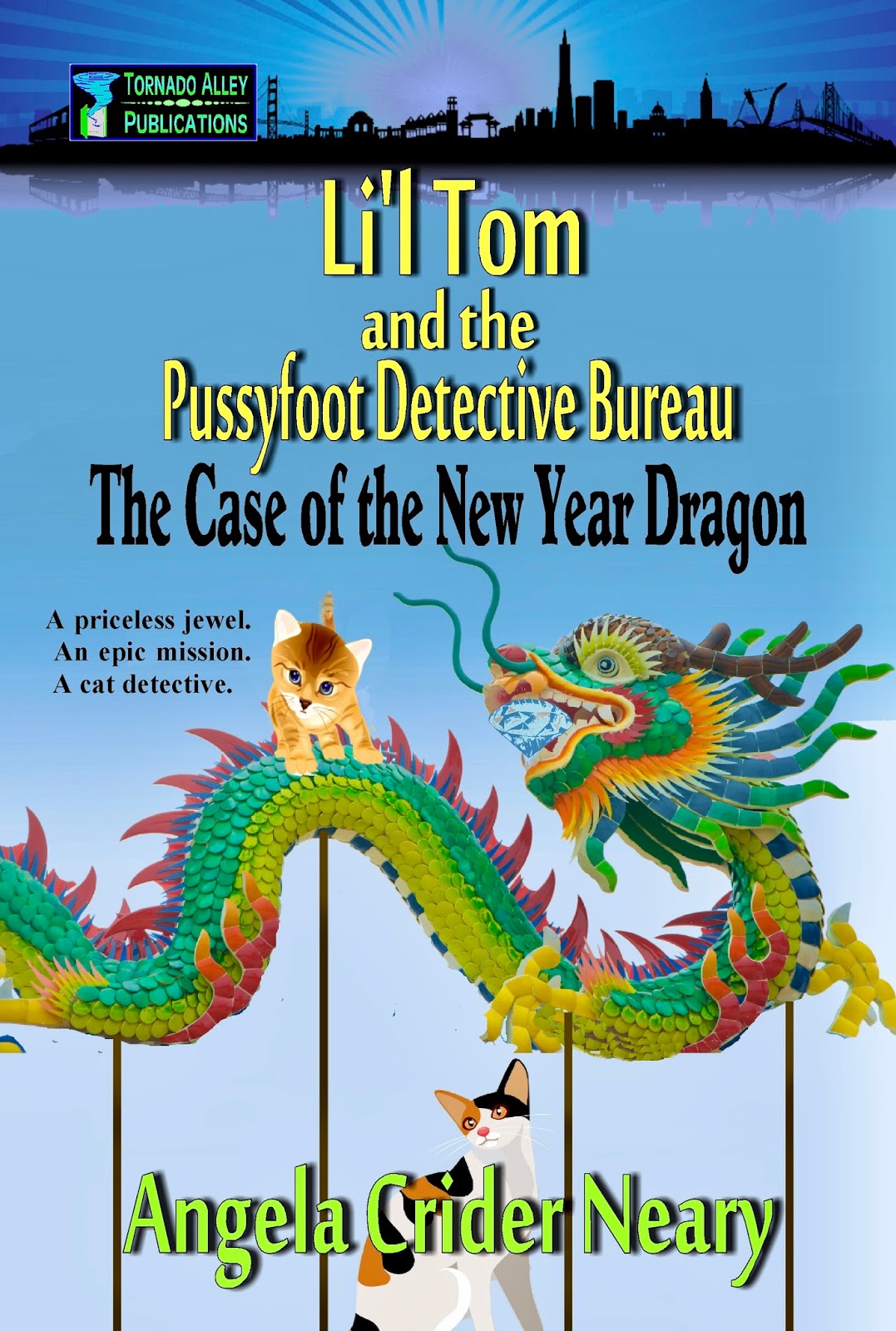
Angela Crider Neary is an attorney by day and writer by night. She is an avid mystery reader and especially enjoys reading novels set in interesting locales. She was inspired to write her first mystery novella, Li'l Tom and the Pussyfoot Detective Bureau: The Case of the Parrots Desaparecidos, by one of her favorite areas in San Francisco, Telegraph Hill.  Her second book, Li'l Tom and the Case of the New Year Dragon is now available.  To learn more, visit her on Facebook and Amazon.

Friday, April 3, 2020

Living in the Twilight Zone


A month ago I had no idea we would all be living in this new somewhat surreal reality. I knew it was only a matter of time before the coronavirus wreaking havoc in China and Italy made its way to our shores. I did not realize just how bad it would be; I don't know that any of us did.

Admittedly, I'm an introvert, so social distancing is my norm. My husband and I began limiting how much we left the house three weeks ago. Now that we have a month or so of it still to go I'm getting a bit twitchy. I miss being able to eat out. Even though I took over primary responsibility for cooking after I retired last year, meal planning is still not my forte. Non-stop meal planning for the foreseeable future? Ugh.

As most anxiety sufferers will attest, anxieties and long-term stress don't mix well. It also doesn't matter how logical the anxiety sufferer is, anxiety itself is not logical. Even though my anxieties are generally well-controlled, I really struggled for a while. When mine were at their worst a couple of weeks ago, I didn't want to eat. Why? Because eating would mean using our supplies and using supplies meant going to the store to restock and the thought of shopping was almost enough to make me hyperventilate. As I said, not logical.

In order to help put my anxieties at ease, we have changed the way we shop. I am now placing orders for groceries and other supplies online and picking them up at the store thereby negating the need to mingle with crowds of people. I know some people have been doing this for ages but it's new to me - it's also wonderful.

Image courtesy of depositphotos.com

However, as of April 1st, COVID-19 is no longer just a faceless specter. It is now wearing the face of my youngest son. My son contacted my husband when he left work on the 1st stating "I think I have it." Once he got home he took a picture of the thermometer - his temp was 102.5 F. I sent him the number of a coronavirus hotline. The hotline told him that he was one symptom away from testing by a mobile unit and to call back if he developed a cough/shortness of breath - and that, effective immediately, he must quarantine himself for 14 days. As of today (April 2nd), he has the cough/shortness of breath and the complete lethargy other sufferers have described. I'm in full mama bear mode. I want to load my car with soup and Gatorade and go see my son, but I can't. In short, this sucks.

These are difficult times and they are going to get worse before they get better. However, they will get better. In the meantime, we need to be kind to each other and love on each other - from a distance of course. Call/text friends, share funny memes, and take time away from the news/social media. Staying connected 24/7 won't change anything except you - and honestly, not for the better.

How are you doing? What are you doing to keep yourself sane during social distancing?


Sign up for my newsletter here:  http://madmimi.com/signups/112968/join


Thursday, April 2, 2020

New Release -- The Coconut Bunny Butt Caper by Livia J. Washburn

A Fresh Baked Mystery Short Story

Zachary “Buck” Williams asks Phyllis to help him throw a big Easter shindig with games and food and an egg hunt, inviting everybody from the whole county to join in the fun.

It’s a beautiful spring day in Weatherford, Texas, as kids are running and playing and parents are chatting and sampling wonderful home cooked foods. It was all fun and games until someone played hide and seek with the prize egg leaving Phyllis having to find the culprit.

The Coconut Bunny Butt Caper is a short story that follows DEATH BAKES A PECAN PIE the fourteenth novel in the critically acclaimed and best-selling Fresh Baked Mystery series. Phyllis and her friends tackle another complex case with all the humor, camaraderie, good-hearted warmth, and delicious recipes that have made readers around the world fall in love with this series.

Recipes included!

EXCERPT

     On a beautiful spring day under an almost cloudless blue sky, Phyllis Newsom smiled as she watched the crowd of children running and screaming across the vast green lawn. They descended on the shrubbery and flowerbeds like a swarm of locusts.

     “Dang,” Sam Fletcher said as he stood beside Phyllis. “Don’t get between a kid and an Easter egg, that’s all I’ve got to say.”
     “They’re certainly enthusiastic,” Phyllis agreed. “This reminds me of the big Easter egg hunts that went on when we were young, and even when Mike was a child. I remember taking him to several of them, sometimes put on by family, sometimes by the community or one of the local service clubs. People don’t do things like that anymore. Not much, anyway.” She shook her head. “Just another way that things have changed, I suppose.”
     “They’ve got a way of doin’ that,” Sam said. “But bringin’ back the old days was sort of the whole idea of this fandango, wasn’t it? 

Thursday, March 26, 2020

Upon Learning the Splendid Craft of Writing by Jodi Lea Stewart


Beginning writers face many obstacles.

Recently, someone asked for advice in a writing group online. She wanted to write novels but said everything stays a draft because she feels too insecure to continue and doesn’t really know what she’s doing. 

Further, each time she writes something, it gets criticized, causing terrible self-doubt. She said she was afraid her dream of being a writer may remain a dream. She asked what she should do.

These are honest problems for beginners, and I would like to shed a little light from my own perspective.

Self-doubt
First of all, every writer goes through the self-doubt stage of wondering if she or he is truly qualified to call themselves a writer. I was still reluctant to do so after writing for university and local newspapers, becoming a western magazine columnist, and  after being made the managing editor/main writer for a Fortune 500 company newsletter.

Why is that?

I believe one reason for the self-doubt is that aspiring writers grow up having so much respect for writers, especially the ones who pen novels and books. We wonder if we have the talent and right to enter into their “sacred” world. Their world seems too full of fire pits and dragons for us to wander into it with our little fluffy *amateur* suits of armor.

To that, I say, be of good courage . . . if you write, you are a writer! Enjoy that fact, even if nothing you have written has ever been published. If you are working hard toward this goal, you are at least a struggling writer, which equals writer!

The best book I ever read on this subject and the one that actually gave me the personal confidence to pursue writing was Brenda Ueland’s book If You Want to Write. She was a journalist, editor, writer, and a teacher of writing and truly believed that anyone with the spark of desire to write can and will if they work at it. It’s an old book, and it’s full of wise and wonderful advice. If you don’t read it, you are missing something you won’t find anywhere else.

About criticism

When you are starting out, simply don’t cast your pearls before swine. In other words, write and then check your own writing. A really good way to do that and one that worked for me, provided you want to write fiction, is Self-Editing for Fiction Writers. If you don’t want to write fiction, there are multitudes of other books that can help you learn how to self-edit. Editing yourself is an important part of writing.

Another thing you must have in your life is someone who doesn’t mind giving sound craft advice and who is also successful at writing and editing. They most likely won’t be someone from your corral of friends, family, jealous acquaintances, general naysayers, or, unfortunately, fellow amateurs in your writing groups who usually have no idea what they are doing either. Sorry, but that’s the truth.

Don’t give others the opportunity to be your critic.

Take it away from them. They don’t get to see anything until you are way down the road and know you are turning out good copy. By then, it’s still not open for debate from other beginners because you have progressed and only work with professionals or other seasoned writers/editors.

So, now that you,

  1. believe you can be, and are, a writer,
  2. are going to stop letting other amateurs critique and belittle you,

How do you turn your dreams into reality?
Hint: It's not by being lazy.


  • More and more, I hear online beginning writers say that becoming a writer involves all-natural talent so no need to read a bunch of books or go sit in a classroom or attend a seminar.
  • Grammar rules? Pffft! Writing is art, so there are no rules.
  • Some actually believe that reading books nowadays is just a waste of time.
  • Others ask the craziest questions they should be researching themselves or not even asking in the first place, such as “How do you write a fiction novel?” and “What is it like to be in love? I want to write a romance novel.” (That one stupefied me).
  • Also, I hear them tell one another that watching YouTube videos about writing is the same as reading a book about it or learning firsthand from experts.

Really?

Let’s pause and consider a few examples.

1.      You smell that certain smell in your home. You jump online searching for an electrician to come immediately before your house burns down, don’t you? Do you know that electrician has more than likely gone through four years of apprenticeship including approximately 8,000 hours of on-the-job training and more than 500 hours of classroom training?

That’s a huge time investment, isn’t it?

2.     The lawyer you call when your drunk neighbor crashes into your car parked in your own driveway and who refuses to take responsibility for it has finished twelve years of lower learning, four years of undergraduate study followed by three years of law school and had to pass the Bar Exam, as well.

Nineteen years of schooling for the privilege of becoming a lawyer!

Whether becoming a carpenter or an airline pilot, a mechanic or a real estate agent, an artist or a writer . . . the bottom line is effort. Every profession demands extensive work and commitment.

Ever hear of the immersion programs for learning a new language? Yeah, it’s like that, but more extended. We learn specialties in life by immersing ourselves in them. Why would anyone think they can become a writer simply because they enjoy writing?

Enjoyment is a by-product of writing, that’s for darned sure, but it isn’t the same as training, practice, trial and error, tutelage, classes, and all that goes into learning a craft.

Say you desire to be an essayist. You already know you have the aptitude because you loved the essay part on all your tests in school while the majority of your classmates found it akin to facing Stephen King’s Pennywise lurking in the gutters. 

Is liking to write essays enough, though? No. You will need to read and study hundreds of essays to finetune your own essay writing. You will need advice, feedback, and constructive criticism.

That’s just one of so many examples.

How about writing novels?

Let me be blunt about this. If you are not willing to study endlessly, challenge yourself continually, read and write almost every day, accept constructive criticism gracefully with the idea of improving in the process, attend writing seminars, know how to spell and use grammar properly, and not be bull-headed when the publisher asks for your manuscript in a certain format whether you think it looks “unartful” or not, then forget about writing novels.

Since I’m a novelist, I warm to that particular subject. Here are my personal tips for beginning novelists:

Read meaningful books, lots of them, on the craft of writing. Go to seminars. Subscribe to the magazine, Writer's Digest. Read novels continually. Write continually. Take a journalism class to learn how to hook readers with your first line, first paragraph, and first page of EVERY chapter. That has helped me more than anything. Learn how to punctuate and spell, and know what current publishers prefer. Right now, for example, Chicago Style ellipses are the proper way to go. Study, and study more. 

In a nutshell . . . 

  • If you want to write, write!
  • If others are pulling you down into the stinky swamp with their unhelpful or mean criticisms, escape! Take yourself and your talents into the sunshine.
  • Lastly, realize that anything worth doing is worth the effort to learn and learn well. It won’t happen overnight. Nothing difficult and incredible does.

Precept upon precept, your knowledge will grow, and so will your confidence. Now, get out there and learn and study and write your head off!


***


Jodi Lea Stewart was born in Texas to an "Okie" mom and a Texan dad. Her younger years were spent in Texas and Oklahoma; hence, she knows all about biscuits and gravy, blackberry picking, chiggers, and snipe hunting. At the age of eight, she moved to a vast cattle ranch in the White Mountains of Arizona. As a teen, she left her studies at the University of Arizona in Tucson to move to San Francisco, where she learned about peace, love, and exactly what she DIDN'T want to do with her life. Since then, Jodi graduated summa cum laude with a BS in Business Management, raised three children, worked as an electro-mechanical drafter, penned humor columns for a college periodical, wrote regional western articles, and served as managing editor of a Fortune 500 corporate newsletter. 

She is the author of a contemporary trilogy set in the Navajo Nation featuring a Navajo protagonist, as well as two historical novels. Her most recent novels are Blackberry Road and The Accidental Road. She currently resides in Arizona with her husband, her delightful 90+-year-old mother, a crazy Standard poodle named Jazz, two rescue cats, and numerous gigantic, bossy houseplants.


1956 . . .

– Historical Fiction
It’s 1956, and teenager Kat and her mother escape an abusive situation only to stumble into the epicenter of crime peddlers invading Arizona and Nevada in the 1950s. Kat is a serious girl who buries herself in novels and movies and tries to be as inconspicuous as possible. Fading into the background is impossible, however, with a beautiful social butterfly of a mother who just happens to resemble Marilyn Monroe. It’s embarrassing, and the unwanted attention her mother garners could be the downfall of their plan to take Route 66 to the freedom of a new life.

Print and eBook available on Amazon.

1934 . . . 

– Historical Fiction
Trouble sneaks in one Oklahoma afternoon in 1934 like an oily twister. A beloved neighbor is murdered, and a single piece of evidence sends the sheriff to arrest a black man that a sharecropper’s daughter knows is innocent. Hauntingly terrifying sounds seeping from the woods lead Biddy into even deeper mysteries and despair and finally into the shocking truths of that fateful summer.

Audible, Print, and eBook available on Amazon, etc.


Monday, March 23, 2020

Wash your hands, Roger - Vintage Lava soap commercials by Kaye Spencer #classictelevision #firestarpress ##vintagecommercials #handwashing


In these crazy-scary days of global health concerns, we have a heightened awareness of the importance of washing our hands to prevent and/or slow down the spread of germs and viruses. Here is a brief history of a soap that was a staple in my house when I was growing up. Whether washing with it retarded the spread of disease is unconfirmed. This soap is

Lava Soap Whatever you’re into, Lava gets it out.


 Pertinent Lava soap facts:

  • heavy-duty hand cleaner
  • originally produced in soap bar form
  • developed by Waltke Company of St. Louis, Missouri in 1893
  • contains ground pumice (hence the name 'lava')
  • moisturizers added in recent years
  • original beige bar without moisturizers is no longer manufactured

  •  comes in green wrapper,red wrapper, and liquid


This advertisement from 1950 promises that washing with Lava soap prevents polio. Unfortunately, there was no documented, scientific proof of this. (More HERE)


Here are  our vintage television commercials extolling the advantages of washing with Lava.

Lava Hand Soap Commercial c. 1965


Lava Soap – “Wash Your Hands, Roger” (1960s or 1970s – conflicting sources information)


Lava Soap c. 1989


Lava Soap c. 1990


My dad and grandpa washed with Lava soap to remove dirt and grease. It worked well. What about in your house? Did your family use Lava soap?


Until next time,
Kaye Spencer


Stay in contact with Kaye—


Resources:
Lava soap information—
https://en.wikipedia.org/wiki/Lava_(soap)
Website: https://www.lavasoap.com/

Vintage Advertisement—
Pinterest. Etsy.com. Lava soap vintage ad c. 1950s. Accessed 2020.03-21. https://www.pinterest.com/pin/356136283019260162/

Vintage lava soap image—
Pinterest. rakukaren.com. Vintage Lava Soap image. Accessed 2020.03-21. https://www.pinterest.com/pin/349521621052204480/