Search This Blog

Showing posts with label moonbase. Show all posts

Monday, September 3, 2018

The Unborn Galaxy series by Michael E. Gonzales


Another rousing BLOG post by Mike Gonzales, the American, Spanish, Englishman.   

I cannot start to tell you how fortunate I am to have been published buy Fire Star Press.


Who among us can’t wall paper their home
with rejection letters? I was once told, by a literary agent I was courting, that “a rejection is not a reflection on you, personally.”

Of course not. It’s just a rejection of the work I poured my heart and soul into. It’s a comment on the vast amount of emotion, consternation, and yes, at times even tears, that I have invested in the telling of that story. It's a comment on that part of me that I have transferred onto that page.


Not that I'm bitter, you understand!

Despite the pain associated with these rejections - I persevered. I still have pinned to my computer the quote by Richard Bach, “An author is a writer who didn't give up.”

The circumstances that brought me into contact with Prairie Rose Publications, as I look back on it, seem highly unlikely. Perhaps even guided by an unseen, all powerful hand. Anyway, that’s how I like to see it.

So here I am, four books on the open market and I still can’t believe it. So, thank you, everyone at Fire Star Press! (Really, can’t say that enough!)

My first published works are a five-book series called, “The Unborn Galaxy.” Each book is a standalone story but they all take place in the same fictional universe. Their commonalities are that they all origin on JILL, the Joint International Lunar Laboratory, and there are bleed over characters. For Example, in “Across a Sea of Stars” Kathy is a minor character popping in and out of the story but only briefly. However, in “The Vampires of Antyllus” she is the main character.


I hope you’ll follow me on this adventure through The Unborn Galaxy, to the Moon, and beneath is cratered surface.


To a battle ground inside the great Moon base.
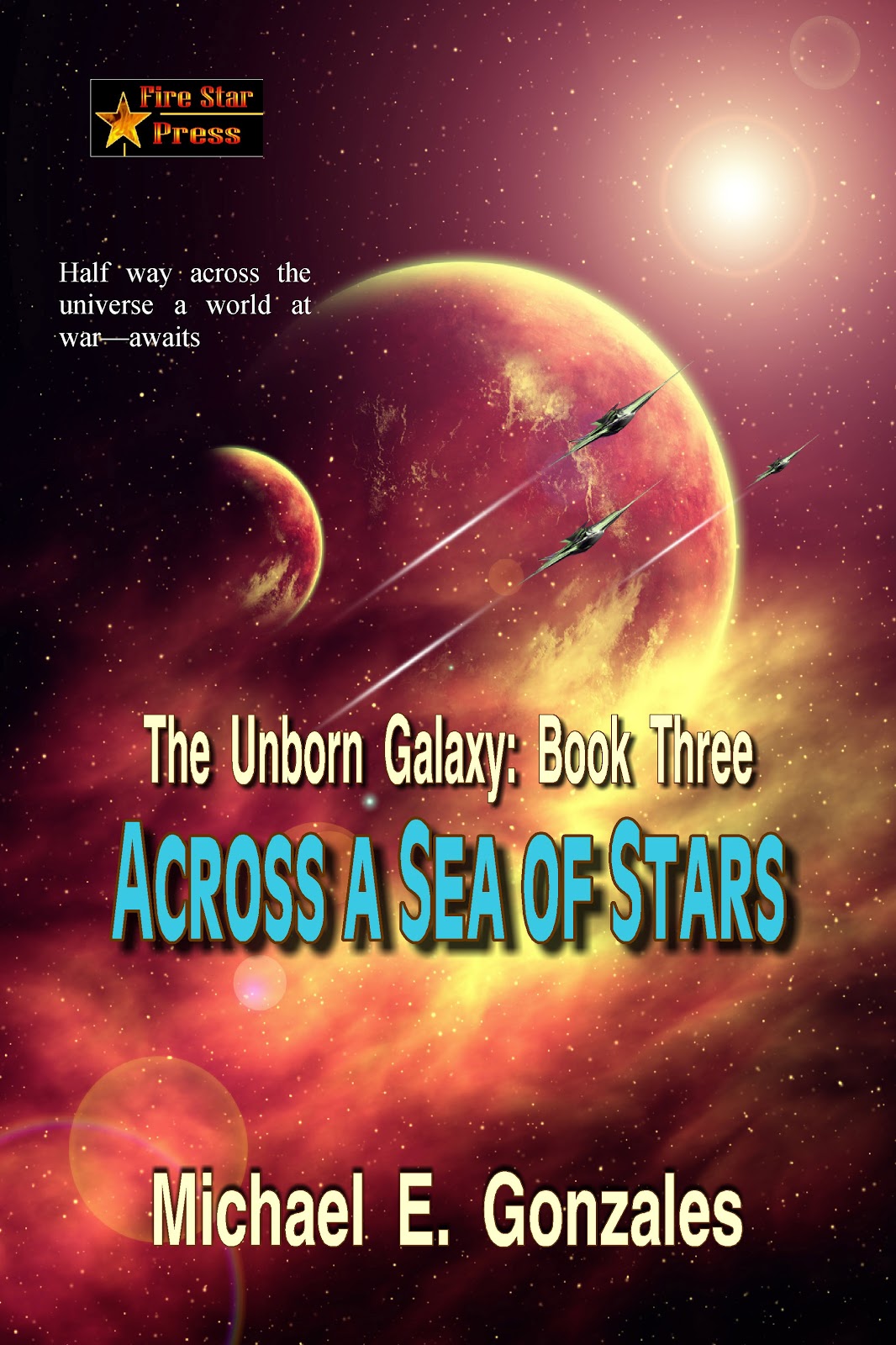


Come, be whisked away from the desolation of the lunar surface to a world of beauty and danger.


And take your position aboard the Demeter for a many years long voyage to another world and a fresh start for humanity, that is, if the promise of this new world doesn’t bring about its destruction.

             Then in the fifth book…              


The Unborn Galaxy; Dark Moon Rising, The Battle of Broken Moon, Across a Sea of Stars, The Vampires of Antyllus - Available through Amazon.com, Kobo, iBooks, Books-a-Million, Walmart.com, and Barnes and Noble.com

Please visit my Web Site:  http://www.mikegonzalesauthor.com/home.html


Thank you!


Wednesday, March 1, 2017

Are we alone? By Michael E. Gonzales

Wow… what a week for science, eh? In addition to the other dozens of exoplanets discovered “out there”, seven new planets were discovered orbiting a relatively close star, TRAPPIST-1, only forty light years away!
Even more remarkable is the fact that three of the seven are located in what’s called the habitable zone, that ring around any given star where water can exist in its liquid form―liquid water is essential to the development of life―“as we know it.”  

These planets are roughly the same size as Earth, possibly older than Earth, so…this begs the question…is there life around TRAPPIST-1?

If so, is it just primordial, single-celled creatures in a soup of life, or mere microbes?
How deep does your imagination run?
Perhaps they are closer in development to Neanderthal man?
Could they be as advanced as we were in say, 1939, living in great cities, in command of electricity, dominating their seas, and flying through their atmosphere?
Or, just maybe, they are more advanced than we. Perhaps they already know about us, their instruments having detected our solar system a millennium ago. Who knows that they haven’t been listening to our transmissions, even visiting us since eons past―and are still?
Then why have they not contacted us? Sent us a signal of some kind?
What if a massive solar flare, or a collision with a comet, or―war, laid waste their once mighty civilization, and all that is to be found on their world is the skeleton of a once learned, cultured people, now lost for all time.
Were they advanced enough to hedge against such an eventuality? Had they outposts on one of the other worlds of TRAPPIST-1? Perhaps colonies far outside their own solar system? The nearest habitable world to theirs lay a mere forty light years away.
Did they come here in man’s distant past? Did they build the pyramids found around the world, were they the builders of Machu Pichu, Teotihuacan, and Angkor Wat? Are we the last vestige of their civilization?


Or maybe…they are on their way here now? A vast armada moving at near-light speed toward a technologically inferior species with the goal of conquest and genocide?


It may be possible that they launched an ark, a vessel containing the DNA of every life form on their world? And should we discover it, would it be wise to open that Pandora’s box?
Are the lines between science, science-fiction, and fantasy beginning to blur? No less a mind than Stephen Hawking warned mankind, “It is perfectly rational to assume intelligent life exists elsewhere. If aliens visit us, I believe the outcome would be much as when Columbus landed in the Americas.” Which, as we all know, didn't turn out well for the Native Americans.
This is the dystopian view.
Another view is that the more advanced a civilization is the less violent, and the more curious. Aliens might very well turn out to be an altruistic race, come to learn and to share their knowledge.
If the decades-long rash of UFO sightings is any indicator, then they are more like Captain Kirk following his prime directive; observe, do not interfere. And like Captain Kirk, doing a lousy job of it.
Seven new worlds. But this is nothing compared to all we have thus far located in a patch of sky no larger than a postage stamp held at arm’s length. Weekly, it seems, dozens of planets from this “tiny” spot are added to the exoplanet database. At this writing, there are 3,453 confirmed planets, and another 4,696 Kepler candidates.
It is likely we will know the answers to the questions posed above sooner than we might suppose.

Watch the skies.
And pick up Books I and II of The Unborn Galaxy -- while there's still time.