Search This Blog

Showing posts with label The Unborn Galaxy series. Show all posts

Monday, October 1, 2018

Experience By Michael E. Gonzales


I started writing a new story that takes place back in 1899, and not because I’m infatuated with 1899 but because it places by characters in the time I need them in to match both historical events and events as written by another, and very famous, writer of science fiction from the genre’s early beginnings.
Next, I have to get them to a very specific location. This will by necessity require me to write about travel. I’m fortunate in that in my life I have traveled a great deal. This provides me some insight. And better yet I have traveled on a ship, which if your traveling about the world in 1899 there is pretty much only horses, trains, and ships to get around on (there were a few automobiles but very, very few).
My characters will have to traverse rugged mountainous terrain as well and dense forests in rolling hills. Yup, you guessed it…I’ve been there, done that.
“Okay, Mike, nuf bragg’n what’s yer point?”
Point is, every writer must draw on what they know and what they have experienced. Does this mean if you haven’t walked twenty-five miles in a day through a forest where the temperature is twenty-two degrees that you can’t write about it? Well, of course not.
First, what I do, is remember a time when I was once bone tired but knew I had to push on. After a hard day at the office ya got one last stop at the store, drag yourself through the isles to get what you need to go home and cook dinner!
Remember when you were last out in very cold weather for a longish time, remember shivering against the cold, pulling your collar up, burying your hand deep in your pockets.
Remember strolling through a fairy tale forest (or seeing a movie set in a fairy tale forest).
Next, I roll up all those memories, extrapolate (a highfalutin word meaning to deduce or guess) and then, here’s the hard part, see yourself dead tired in a freezing wood with miles to go before you sleep.
Again, I realize I’m preaching to the choir here and I know that very likely every one of you has a different method to achieve this same goal. And I am also aware that there are some of you who when describing walking dead tired in a freezing wood with miles of path ahead―have actually done that (you poor thing, you!).
It can be even more difficult if your having to describe events on an alien world, or in the weightless environment of space (and no, I’ve not been into space―yet).
It’s been said countless time, “there is no substitute for experience,” and that is so true, particularly for writers. The big difference is that for everyone else experience is something to draw on to improve some aspect of your life, but a writer has to have the ability to describe that experience in the most vivid and emotional manner possible.
You write about the death of a beloved character in your story. As painful as it might be, recall the death of a friend, a parent, a loved one. Bring up all the pain that you spent years suppressing and pour your tears onto the page. Hold nothing back.
If it doesn’t make you cry, neither will it your reader.
One of the most difficult things I have experienced about writing is the pain of vomiting up old memories, and the struggle to put that pain on paper.
If done well, you will know the joy of having written something people, hopefully, will want to read while at the same time experiencing your own cathartic event.
                                   Just keep writing! 


Please visit my Web Site:  http://www.mikegonzalesauthor.com/home.html


Monday, August 6, 2018

Conflict, by Michael E. Gonzales


The one common denominator in all fiction stories, regardless of genre, is conflict.

Whether it is the conflict brewing within the hearts of lovers, or the international conflict between nations, or even worlds, it is conflict that drives our stories.


It has been said that there are really only two stories; someone enters town, someone leaves town. Whichever your story starts with there must eventually (and rapidly) be conflict.

Why? Because it is conflict and its ultimate resolution that the reader craves.

The key is to invent a unique conflict and an even more unique resolution. In between the story must titillate, entice, direct and misdirect the reader. He must be entertained, amused, and often scared senseless. 

How hard can that be?

This is the job of the fiction writer.


Additionally, the more conflict in your story the better. A band of unlikely heroes departs on a desperate journey to save their world from a villainous despot. Among them are two whose races have hated each other since beyond the reach of memory, record, or tradition. A man and a woman who despise one another. Another who holds all with him in low regard.

So, in addition to the obvious bad guy, the villainous despot, you have all that lovely conflict between the heroes. (The lord of the Ring comes to mind).


With so many characters in conflict it is imperative you keep meticulous records on each. A detailed description of the character physically, a list of his strengths and his weaknesses, and a bio detailing who she is, where she has been, what she has done and of course, her antecedents.

You must also map out each conflict to its end. And keep in mind not all resolutions have to be happy endings. “Death come to us all.” I have read stories where the hero fails and dies in the end, but recent events in my literary life have proven to me that the timing of such deaths is of paramount concern.

In conclusion I submit that the conflict in our stories is our story.

“Nonsense!”

“Who said that?”

“I did! You could not be more wrong! I have enjoyed several novels that contained no conflict!”

“Name one.”

“The Mezzanine, by Nicholson Baker.”

“Okay, you may be right there. It’s a story entirely without a plot. It relates the thoughts of a man over the course of his lunch break. He snaps a shoelace, and by the end of the story, he manages to buy a new pair. That's about it. And even then, it could be argued, the conflict was between the man and his shoes.”

“Hmm…a man and his shoes?”


“Conflict. Learn it, embrace it, love it.” 


 Please visit my Web Site:  http://www.mikegonzalesauthor.com/home.html


Thank you!


Tuesday, January 30, 2018

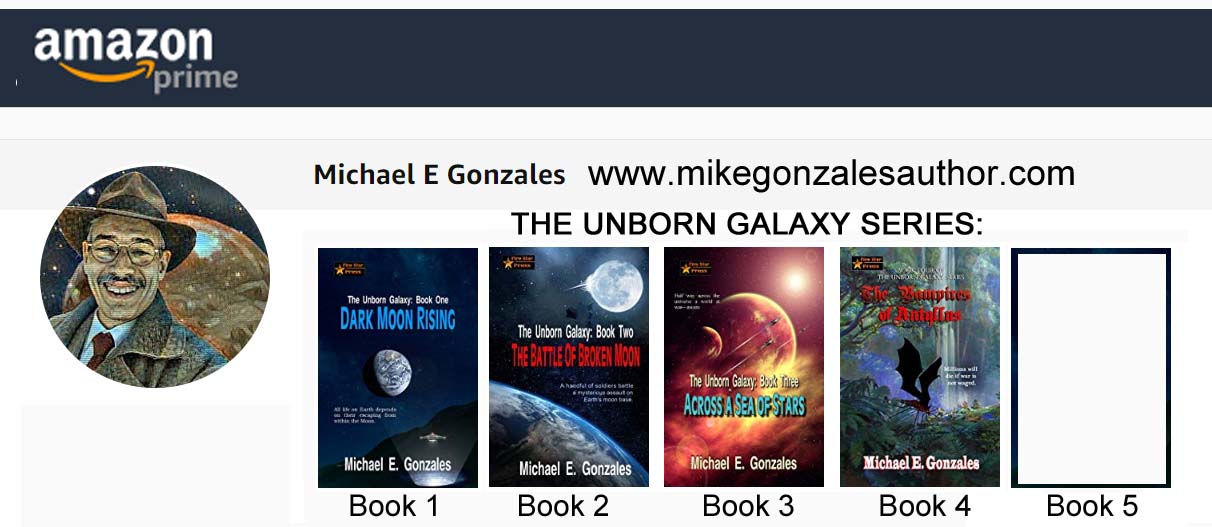
New Release -- ACROSS A SEA OF STARS (The Unborn Galaxy Book 3) by Michael E. Gonzales -- #firestarpress

Astronaut Cris Salazar is assigned to the Moon colony, JILL, for the study of an enigmatic singularity on the lunar surface. During an experiment within the crater Hohmann, Cris is captured in a peculiar gravitational field and is transported halfway across the universe.

His craft is wrecked in a strange world, and though he survives, he learns that his rough landing has accidently killed the son of the tyrannical ruler—and now, Cris must pay…or escape. But how can he leave innocents to face the chaos he’s inadvertently caused?

The inhabitants of this alien civilization come to Cris’s aid, and a wizard sets him on a quest that seems impossible to accomplish alone. But as he sets out on this dangerous mission, Cris is joined by a mystical and beautiful huntress, a near-giant, and a robotic intelligence.

Bloody battle and gut-wrenching loss in his own past have left Cris heartsore and reckless, but a journey that begins as a desperate bid for his own survival takes on new meaning as he finds something—and someone—to care about once more.

With billions of lives at stake—including those who have joined him in the deadly fight against advancing evil forces, Cris embraces a destiny he could never have anticipated from light years away ACROSS A SEA OF STARS...

EXCERPT:

     Cris dismounted his Eagle and had reached the side of the LPC, his internal coms set to the emergency freq. "Charlie, this is Eagle, I'm right outside—can you hear me?" There came no response. "Charlie, can you open the hatch? I'm right outside your hatch!"
     Cris saw the hatch quiver, and then it popped open a few centimeters at the top. This hatch was hinged at the bottom. Undamaged, this door would have come down and become a set of stairs allowing access to the interior, but the hull was now warped, jamming the hatch. Cris grabbed the door along the top and pulled with all his might. Inside, the one uninjured man and the wounded man with the still-intact suit were pushing with all their strength. The door held up well, but at last gave in and came crashing down to a surface now level with the bottom of the LPC.
     Cris looked up to see one of the men collapse and the other bend down to aid him. Cris rushed in and grabbed the standing man. He looked up into Cris's face, fear written in his expression. "Can you hear me?" Cris asked, mouthing the words as he spoke aloud. The other man shook his head.
     Cris rushed in beyond these two in order to locate the man with the damaged suit. There he was, unconscious on the floor, an emergency suit repair applied to his right leg. There was also a good amount of blood frozen to the deck. Cris again grabbed the uninjured man, pointed at the unconscious man and the floor, held up one finger, and mouthed, "First." 
     The other man nodded. They both grabbed the injured man and headed for the Eagle. Once there, Cris opened the airlock, and together they got the unconscious fellow inside. He indicated to the other man to get into the airlock with the injured man in order to operate the mechanism. As the man started climbing aboard, Cris went back to gather the man on the floor who showed no obvious wound, but was nonetheless dazed. He put his arm around him and aided him back toward the Eagle.
     As the Eagle's airlock door was opening, a familiar and aggravated voice came over his coms. "Hatchling Three, this is Mother Bird, what's your status? Over." 
     "Mother Bird, I am engaged in a rescue operation, I have three survivors, two are wounded, one severely, please notify medical, I will be inbound to Hotel Sierra in five mikes with an ETA of forty mikes. Over."
     The tone of the voice changed dramatically. "Roger, Hatchling Three, wilco. Keep us advised. Out."
     

Sunday, September 3, 2017

Which Book? By Michael E. Gonzales


I have often asked myself, “What makes the reader, of any given genre, choose one book over another?”

Number one, of course, is author recognition.

However, as I can a test, new, unknown authors oft times get their books read too.

There are many factors, the synopsis, the title, the cover, the reviews, and of course a good marketing plan.

But when the rubber meets the road it’s a reader, sitting at his computer, or standing by the shelves in a bookstore, who makes the final choice. With luck, it’s your book (or better yet, mine) that she purchases.

But why?

On Amazon, there are over six million titles. What induced the reader to select one book over the other?

Oh…I wish I knew.

There have been studies, of course, they can tell you what age group of what gender buys what genre, in what quantiles, at what time of year…during a full moon.


I’m sure keener, cooler, more analytical minds than mine can put this data to good use. Would that I was one of them.

Characters too, will aid a reader in that decision. A fellow writer recently asked, “What is it that makes a character memorable?” an outstanding question!
Memorable characters have been both protagonist and antagonist. In Lord of the Rings, Frodo is as well remembered as Sauron.

Few remember Professor Pierre Aronnax, but none can Forget Captain Nemo.

Do we look for ourselves in the hero of a story? And what if we see our reflection in the villain?

In a comment from a woman who read Dark Moon Rising, my first novel, she lamented that I had spent too much time on character development, she thought I should jump right into the action. In fact, we’ve all read stories where you get to know the characters as the main body of the action unfolds.

This is not at all wrong, of course. It has been said that if you don’t grab the reader’s attention on the first page, better the first paragraph, then you never will. No pressure there.

I like to have my protagonist, and some of his back story, developed before I drop him, or her, into the thick of things. Think of the Wizard of OZ, we pretty well know Dorothy before she piggybacks a ride on that twister.

In Across a Sea of Stars, we’ll get to know Captain Chris Salazar, before he’s off the see the wizard. But as the story unfolds we’ll learn he is a very troubled young man who is, literally, haunted by his past.

The plethora of characters Chris meets on his journey will of course develop as the story unfolds. We will like some of them a great deal, love several more, and totally despise others.


In Across a Sea of Stars I have blended Science-Fiction with Fantasy, and Romance, and created a story that I believe will captivate every reader no matter your age, gender, or favorite genre. It will enthrall you no matter how many you purchase, regardless of the month of year…and during any phase of the moon.

You may have noted that I failed to answer even one of the questions posed in this piece, that's because I'm still learning. And frankly I think the answers to the questions will all be very subjective. I don't believe, as I once did, that there is a magic writing formula out there kept a closely guarded secret by a select kabal of wildly successful authors.

The real answer is talent and imagination, and though you can get a definition for each in the dictionary, the concepts are still subjective. We've all discussed popular books with others, and though most love them, there are always those who consider the author a no talent bum. 

I believe it was PT Barnum who said, I will paraphrase him here,
"You can please some of the people all of the time, and all of the people some of the time, but you can't please all of the people all of the time."

By this I mean to say, there is an audience out there for every author.


Please Visit my page, Michael Gonzales, fictionist:http://www.mikegonzalesauthor.com/home.html


Wednesday, March 1, 2017

Are we alone? By Michael E. Gonzales

Wow… what a week for science, eh? In addition to the other dozens of exoplanets discovered “out there”, seven new planets were discovered orbiting a relatively close star, TRAPPIST-1, only forty light years away!
Even more remarkable is the fact that three of the seven are located in what’s called the habitable zone, that ring around any given star where water can exist in its liquid form―liquid water is essential to the development of life―“as we know it.”  

These planets are roughly the same size as Earth, possibly older than Earth, so…this begs the question…is there life around TRAPPIST-1?

If so, is it just primordial, single-celled creatures in a soup of life, or mere microbes?
How deep does your imagination run?
Perhaps they are closer in development to Neanderthal man?
Could they be as advanced as we were in say, 1939, living in great cities, in command of electricity, dominating their seas, and flying through their atmosphere?
Or, just maybe, they are more advanced than we. Perhaps they already know about us, their instruments having detected our solar system a millennium ago. Who knows that they haven’t been listening to our transmissions, even visiting us since eons past―and are still?
Then why have they not contacted us? Sent us a signal of some kind?
What if a massive solar flare, or a collision with a comet, or―war, laid waste their once mighty civilization, and all that is to be found on their world is the skeleton of a once learned, cultured people, now lost for all time.
Were they advanced enough to hedge against such an eventuality? Had they outposts on one of the other worlds of TRAPPIST-1? Perhaps colonies far outside their own solar system? The nearest habitable world to theirs lay a mere forty light years away.
Did they come here in man’s distant past? Did they build the pyramids found around the world, were they the builders of Machu Pichu, Teotihuacan, and Angkor Wat? Are we the last vestige of their civilization?


Or maybe…they are on their way here now? A vast armada moving at near-light speed toward a technologically inferior species with the goal of conquest and genocide?


It may be possible that they launched an ark, a vessel containing the DNA of every life form on their world? And should we discover it, would it be wise to open that Pandora’s box?
Are the lines between science, science-fiction, and fantasy beginning to blur? No less a mind than Stephen Hawking warned mankind, “It is perfectly rational to assume intelligent life exists elsewhere. If aliens visit us, I believe the outcome would be much as when Columbus landed in the Americas.” Which, as we all know, didn't turn out well for the Native Americans.
This is the dystopian view.
Another view is that the more advanced a civilization is the less violent, and the more curious. Aliens might very well turn out to be an altruistic race, come to learn and to share their knowledge.
If the decades-long rash of UFO sightings is any indicator, then they are more like Captain Kirk following his prime directive; observe, do not interfere. And like Captain Kirk, doing a lousy job of it.
Seven new worlds. But this is nothing compared to all we have thus far located in a patch of sky no larger than a postage stamp held at arm’s length. Weekly, it seems, dozens of planets from this “tiny” spot are added to the exoplanet database. At this writing, there are 3,453 confirmed planets, and another 4,696 Kepler candidates.
It is likely we will know the answers to the questions posed above sooner than we might suppose.

Watch the skies.
And pick up Books I and II of The Unborn Galaxy -- while there's still time.

Wednesday, February 1, 2017

On Writing Science Fiction by Michael Gonzales

Writing Science Fiction demands something that many other genres do not. It demands that the author conceive a future technology for our planet, or invent an altogether alien technology. 

We’ve all seen the movies, and the TV shows depicting life thirty and a hundred years into the future. Everyone is wearing silver jumpers, living in skyscrapers that tickle the ionosphere, and the air is filled with flying buses and other public transportation.

For those long trips, say to Tokyo or Berlin, there are super-sonic trains in glass tubes moving at near super-luminal speeds, putting you at your destination in mere minutes.

It’s all so familiar to us—and that’s the problem. Trying to be new, fresh, original in this, the twenty-first century, is a real challenge.


On the other hand, an author these days does not have to spend a chapter and a half describing the Utopian citadel wherein characters reside; just a few key descriptors and the average reader can easily recognize the metropolis of the future—in their already-programmed minds.

Still, what writer of SciFi can resist trying to accomplish what Jules Verne did in 1863 in one of his earliest novels, “Paris in the Twentieth Century.” His descriptions of society and technology a hundred years in the future were frighteningly accurate.


A testament to this fact is the reaction he got from his publisher, Pierre-Jules Hetzer, who refused to release the book because he thought it too unbelievable.

The book's description of the technology of “1960” was in some ways remarkably close to actual 1960s technology. The book described in detail advances such as cars powered by internal combustion engines ("gas-cabs") together with the necessary supporting infrastructure, such as gas stations and paved asphalt roads, elevated and underground passenger train systems, and high-speed trains powered by magnetism and compressed air, skyscrapers, electric lights that illuminate entire cities at night, fax machines ("picture-telegraphs"), elevators, primitive computers which can send messages to each other as part of a network, resembling today’s Internet (described as sophisticated electrically powered mechanical calculators which can send information to each other across vast distances), the utilization of wind power, automated security systems, the electric chair, and remotely-controlled weapons systems, as well as weapons destructive enough to make war unthinkable.

The book also predicts the growth of suburbs and mass-produced higher education (the opening scene has Dufrénoy attending a mass graduation of 250,000 students), department stores, and massive hotels. A version of feminism has also arisen in society, with women moving into the workplace and a rise in illegitimate births. It also makes accurate predictions of twentieth century music, predicting the rise of electronic music, and describes a musical instrument similar to a synthesizer, and the replacement of classical music performances with a recorded music industry. In addition, it predicts that the entertainment industry would be dominated by lewd stage plays, often involving nudity and sexually explicit scenes.

With Hetzel’s refusal to publish, Verne locked the manuscript in a vault where it languished for 131 years before being discovered by his great-grandson in 1989. It was first published in 1994.


THAT, my friends, is forward thinking. He was able to describe things not in existence at that time because he stayed abreast of scientific advancement in his own time. Equipped with a knowledge of where science had come from, where it was, and what it was aiming for, Jules Verne extrapolated the future, accurately, a century in the future. Incredible!

As for alien tech, well, the sky’s the limit (no pun intended). We are a long way from the flying saucers of the 1950s. Today alien spacecraft have been described, in Science Fiction, as everything from massive cities in space to living biological creatures, harnessed to transport the aliens anywhere they care to travel. 

Alien space craft can be anything you can conceive, tiny ethereal objects of light with dimensional anomalies that allow them access to the multiverse, with limitless capacity to transport entire populations, or vast armies.
The aliens could even come to us with no spacecraft at all. Imagine a mind so powerful it can place itself anywhere it can comprehend in the blink of an eye. An alien life with no corporal form.

And if such a wraithlike life existed, what could they possibly see in us? What indeed?

I relish such questions and enjoy trying my best to answer them in a manner that my readers will find entertaining, or better yet…riveting.

Follow me then into worlds beyond our own. The next three stories in The Unborn Galaxy series will take us far from our tiny blue orb to worlds of SciFi adventure mixed with Fantasy and Romance.


I’ll not claim to be a Jules Verne, no one can, but I have called upon a power granted me by an other-worldly entity that allows me to tap into vast reservoirs of imagination; that, combined with the ability to spin a yarn, will provide you, dear reader, with an experience I hope will entertain and enlighten.   


Mike Gonzales

https://www.amazon.com/…/B01CB…/ref=cm_cr_arp_d_product_top…
https://www.amazon.com/Battle-Broken-Moon-Un…/…/ref=asap_bc…
Follow me on Face Book: https://www.facebook.com/profile.php?id=100010275572869